Veronika Hidaši Turiničová, Mgr., PhD.
Researcher, Scientific Research Department
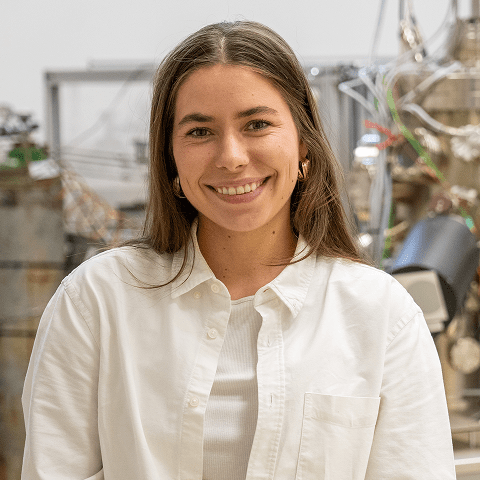
Bio
Young researcher working in the area of solid-state physics at CENAM, focusing on the combination of biomaterials, their electrical modification, and electrohydrodynamics. Operator of the X-ray photoelectron spectroscopy with more than 5 years of experience. The field of interst includes thin films, physical vapor deposition, spark plasma sintering of bulks, electret formation, adsorption processes, chemical analysis, and last but not least, the pendant drop method.
Specialization research areas
Biomaterials Hydroxyapaptite Pendant drop Electrohydrodynamics Physical vapor deposition X-ray photoelectron spectroscopy Surface engineering Surface modification Electret Spark plasma sintering Thin ceramic films Thermal stability Structure analysis Analysis of chemical composition Scanning electron microscopy X-ray diffractionEducation
PhD thesis: A new advanced method for measuring electric charge in charged dielectric hydroxyapatite.
Diploma thesis: Electrical modification of calcium phosphate thin films for biomedical applications
Bc. thesis: Study of electrical modification of materials using a hanging drop in an electric field
Bc. thesis Study of dielectric biocompatible hydroxyapatite
Diploma thesis: Electrical modification of biomcompatible hydroxylapatite and study of surface tension and electric charge using tensionmeter.
Internships
A three month internship under the supervision of professor Grzegorz Greczynski, head of the Fundamental Science of Thin Films unit
A three month internship at the Department of Physics
Scientific assistant in the laboratory of X-ray, Ultraviolet and Auger spectroscopy
Other activities
Veda v Jaskyni o.z.
Awards
The Dilip Das-Gupta Memorial Award - IEEE for the best oral presentation by a young scientist or engineer
Academic commendation of Rector of Comenius University for academic excellence and active participation in Student Part of the Academic Senate
Graduated with honours
Teaching activities
Courses taught
Course Objectives
The main objective of the project is to support the innovation of study programmes at universities by creating courses focused on developing students’ entrepreneurial and innovation potential through the acquisition of relevant knowledge and the development of key entrepreneurial skills. Completing the newly created course aims to encourage students to pursue their own entrepreneurial ideas and to enhance their readiness for the needs of the current labour market. Finally, the project also seeks to strengthen the connection between academia and the business sector through collaboration with experienced industry professionals.
Syllabus
1. Commercialization of scientific research.
2. Fundamentals of entrepreneurship and startup terminology.
3. Identification of problems and customer needs analysis (design thinking).
4. Technology transfer. Technology Readiness Levels (TRL).
5. Intellectual property and its protection.
6. Market, customer, and market potential of a technological solution.
7. Business Model Canvas. Revenue models.
8. Sources of financing for technological projects.
9. Pitching and communication of the solution.
10. Fundamentals of management and leadership.
11. Innovation support and incubation structures at national and international levels.
Course Objectives
Students acquire essential knowledge of principles and properties of basic digital circuits. Gain practical experience to design and construct digital electronic devices and programing selected microprocessors and simple robotic systems.
Syllabus
Course Objectives
Acquisition of skills in registration and data processing by computer, measurement of electrical and magnetic quantities. Physical interpretation and written / graphic presentation of processed results.
Syllabus
In the initial two or three exercises, joint acquisition of skills and measurement with analog and digital devices (oscilloscope, digital multimeter, A / D converter), processing of measured data by computer. This is followed by five to six separate laboratory works on electricity and magnetism selected from the offer: electrical properties of substances – electric bridges, Hall effect; electric field mapping; magnetic field mapping – air coils; electromagnetic induction – transformer; electrical RLC oscillations – transient RLC phenomenon, serial and parallel RLC circuit; magnetic properties of substances – hysteresis loops, permeability of substances, separation of magnetic losses; fuel cell; determination of the specific charge of an electron (e / m0).
Students supervision
Supervisor of bachelor students.